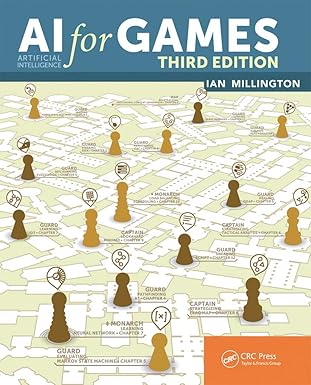
Quick Facts
- Author: Ian Millington
- Edition: 4th Edition
- Pages: 1012
- Publisher: CRC Press
- Publication Year: 2021
Artificial Intelligence for Games Review
Overview
Artificial Intelligence for Games is the definitive guide to implementing AI in video games. From basic movement algorithms to advanced decision-making systems, this comprehensive text covers everything a game developer needs to create compelling and intelligent game behaviors.
Key Topics Covered
- Movement and Pathfinding
- Decision Making and Behavior Trees
- Tactical and Strategic AI
- Learning and Neural Networks
- Board Game AI
- Performance Optimization
- Debugging AI Systems
Review
Having implemented various AI systems in games, I can confidently say that Millington's book is the most comprehensive and practical resource available. It strikes an excellent balance between theoretical foundations and practical implementation details.
The book's strength lies in its systematic approach to game AI. Starting with basic movement and pathfinding, it gradually builds up to complex decision-making systems and advanced techniques like machine learning. Each concept is explained with clear diagrams, pseudocode, and real-world examples from popular games.
The sections on behavior trees and decision making are particularly valuable. Millington not only explains how these systems work but also provides detailed insights into when and why you'd choose one approach over another. The practical examples help you understand how these concepts translate into actual game scenarios.
The fourth edition brings welcome updates covering modern AI techniques, including deep learning applications in games. However, it maintains its focus on practical, reliable techniques that can be implemented with reasonable resources - a crucial consideration for most game projects.
One of the book's most valuable features is its extensive coverage of optimization and debugging. Game AI needs to be not just intelligent but also efficient, and Millington provides numerous techniques for achieving both goals. The debugging chapters are especially helpful, offering strategies for testing and refining AI behaviors.
Pros and Cons
Pros
- Comprehensive coverage
- Practical examples
- Clear explanations
- Updated AI techniques
Cons
- Dense material
- Math prerequisites
- Limited Unity/Unreal specifics
Who Should Read This?
This book is ideal for:
- Game programmers implementing AI systems
- Students studying game AI development
- Professional developers transitioning to game AI
- Anyone interested in understanding game behavior systems